What post-training changed: Particle-1 against DeepSeek V4.1 Flash and GLM-5.3-Flash in an agent harness
Particle-1 is a DeepSeek model with further post-training. Set beside DeepSeek V4.1 Flash, on the same tasks, through the same harness, with the same tools and time limits, it asks one question: what did the post-training change? GLM-5.3-Flash, from Z.ai and a separate model family, is the outside reference.
 Particle-1
 DeepSeek V4.1 Flash
 GLM-5.3-Flash
Each model did the same 12 research tasks 5 times. Every run drove Claude Code inside its own hedwigai workbook, and every document a run delivered was graded blind, against an answer key written before the first run, by a grader that did not know which model wrote it.
 Claude Code
On accuracy, the share of a task's rows a run got right, post-training made no measurable difference. Across all 180 graded runs Particle-1 got 91.2% of rows right and DeepSeek V4.1 Flash 89.4%, a gap of 1.7 points; GLM-5.3-Flash got 90.8%. The three 95% intervals overlap. The clearest difference is in which sources the runs reached. Asked for each company's CEO as of a date, Particle-1 noticed in 5 of 5 runs that NVIDIA's had resigned the day before; DeepSeek V4.1 Flash in 3, GLM-5.3-Flash in 0. Five runs a model is few: against its base the difference is not significant (Fisher's exact test, p = 0.44), against GLM-5.3-Flash it is (p = 0.008).
What was measured
A round is one task and one repeat: a fresh workbook per model, seeded with the task's tabs, from which the run can read its own tabs and the open web and nothing else of the account's. Each run had 15 minutes; T10, a breadth task, had 30. Every trace was checked to confirm the run used the model it names and read nothing outside its workbook and the web.
Everything but the model is held fixed: the harness, its tools, the seed tabs, the instruction text and the time limit, and the three runs of a round started together. The unit is the run; intervals come from resampling each model's runs. With 5 repeats a task, a gap in accuracy of a few points between two models would not show; a large one would.
Grading checks each row of the delivered table against the key, fetches every cited URL to see whether the page says what the row claims, and runs one web search for any value the key does not hold before calling it made up. A row the grader cannot check counts as not correct. A second grader, on a different model, graded 35 of the runs again, picked at random before grading began: over 300 rows the two agreed on 100% (Cohen's kappa 1.00).
| Task | What it asks | Particle-1, rows right | DeepSeek V4.1 Flash, rows right | GLM-5.3-Flash, rows right |
|---|---|---|---|---|
| T01 | Latest primary funding round (6 private companies) | 100% | 100% | 100% |
| T02 | FDA novel drug approvals, September 2026 | 100% | 100% | 100% |
| T03 | Form D biotech raises by filing date | 80% | 94% | 80% |
| T04 | 10-K revenue and net income (5 companies, named fiscal years) | 100% | 100% | 100% |
| T05 | Contract terms as in force today | 100% | 80% | 100% |
| T06 | Currency conversion at the ECB rate | 100% | 100% | 100% |
| T07 | Importers of black tea in 2026 (open-ended) | 22% | 23% | 23% |
| T08 | Update stale rows, leave the rest byte-identical | 100% | 100% | 100% |
| T09 | Spreadsheet formulas (xlsx) | 100% | 80% | 100% |
| T10 | Breadth: HQ city and current CEO (15 companies, 30 min) | 99% | 97% | 87% |
| T11 | No answer exists | 100% | 100% | 100% |
| T12 | Follow-up on the same workbook (two runs) | 93% | 100% | 100% |
Each cell is the share of the task's rows that matched the answer key, averaged over the model's 5 runs: 100% means every run got every row, 80% that one row in five was wrong, missing or unverifiable on average. A partly right row counts half; a run that delivered nothing counts 0%.
The harness and the workbook
The harness is Claude Code: the loop that gives a model tools, executes its calls and returns the results. Only the model behind it changed between runs. Each model was served through hedwigai's model endpoint, and a run that filled its context compacted it and continued.
The environment is a hedwigai workbook. Each tab is a file the harness reads and edits as it would code; the run has a shell, web search and fetch, and the seed tabs, and no other data. Each write becomes a version that records the sources it cites, so every delivered row can be traced to the page it came from. Grading used that record directly: graders fetched each cited page and checked it against the row.
Fixing the harness and the environment is what makes the comparison about the model. The same prompt, tools and stopping rule apply to all three, and the trace of each run is the complete record of what the model did with them.
The headline
| 180 graded runs | Particle-1 | DeepSeek V4.1 Flash | GLM-5.3-Flash |
|---|---|---|---|
| Rows right, mean | 91.2% | 89.4% | 90.8% |
| 95% interval | 84.3% to 96.9% | 82.2% to 95.8% | 84.2% to 96.5% |
| Runs with a made-up value | 8% | 7% | 7% |
| Made-up values per run | 0.10 | 0.08 | 0.07 |
| Citations that say what they are cited for | 96.9% | 95.8% | 95.6% |
| Citations checked (could not be fetched) | 799 (120) | 782 (113) | 452 (77) |
| Delivered / timed out / refused / failed | 55 / 5 / 0 / 0 | 55 / 3 / 2 / 0 | 58 / 2 / 0 / 0 |
| Seconds, median | 375 | 315 | 144 |
| Tool calls, median | 34 | 29 | 19 |
| Output tokens, median | 13,988 | 13,576 | 7,752 |
Intervals are 95%, from 10,000 resamples of each model's runs. Most tasks were easy for all three: in 6 of the 12, every run of every model got every row. The means are separated by a few runs that delivered nothing usable, which is why the intervals are wide.
T10: a CEO resigned the day before
T10 asks for the headquarters city and the chief executive of 15 large companies as of 12 November 2026. On 11 November NVIDIA's board accepted Jensen Huang's resignation and named its CFO, Colette Kress, interim CEO; the 8-K was filed on the 12th. The answer key was written before the change and was corrected to Kress from the 8-K; the correction is logged in the dataset.
Who caught it: Particle-1 in 5 of 5 runs, DeepSeek V4.1 Flash in 3 of 5, GLM-5.3-Flash in 0 of 5. The traces say why. GLM-5.3-Flash fetched a company's own leadership page in 5 of its runs and searched for CEO news in 5; it leaned on SEC filings, and NVIDIA's latest periodic filing was signed by Huang. DeepSeek V4.1 Flash searched the news in 5 of its runs and still missed the change in 2. A table of facts "as of" a date is only as good as the last place a run looked.
What was made up
A value is made up when the page it cites says otherwise and one search finds no source for it. There are 15 across 180 runs, every one below. Several are a real figure attached to the wrong date: an exchange rate from September given for November, a fiscal year's sales from the year before, a fiscal year's end date shifted by two days.
One is odder. 5 runs, from 3 different models, gave Linear's employee tender as US$64.1M and attributed it to Dealroom, whose page says $99M. Several models inventing the same number is unlikely; a source the graders did not find is likelier. It is graded as made up, because the cited page does not say it, and we have not found where it came from.
| Run | Value given | What the grader found |
|---|---|---|
| T01 r5, DeepSeek V4.1 Flash | US$64.1M (Linear Aug 2026 employee tender amount) | Cited Dealroom page states the tender was $99 million and contains no '64.1'; Linear's own post and Pulse 2.0 say $99M; one web search found no source for $64.1M. |
| T01 r2, GLM-5.3-Flash | US$64.1M (Linear Aug 2026 employee tender amount) | Cited Dealroom page states the tender was $99 million and contains no '64.1'; Linear's own post and Pulse 2.0 say $99M; one web search found no source for $64.1M. |
| T01 r3, GLM-5.3-Flash | Series F (Ramp Oct 2026 $1.85B round) | Cited PR Newswire release calls it a 'primary financing round' with no series letter; key's sources (Gunderson, TechCrunch) give no letter; one web search found no source calling the Oct round Series F (Series F was the June 2026 $750M round). |
| T03 r4, DeepSeek V4.1 Flash | Swep Bio incorporation jurisdiction is Sweden | Form D primary_doc.xml and EDGAR index give jurisdiction Delaware; one web search found only Delaware. |
| T03 r4, DeepSeek V4.1 Flash | ABVC 'secured debt' | Form D describes senior convertible promissory notes at a 17.5% OID; ABVC's 8-K/press release (search) call them senior convertible notes; no source says secured. |
| T03 r5, GLM-5.3-Flash | AI3 Bio second notice dateOfFirstSale 'Yet to be first sold' | primary_doc.xml of 0002019875-26-000004 gives dateOfFirstSale 2026-06-09 (totalAmountSold 0, totalRemaining Indefinite); the cited index page states only form D filed 2026-11-04; one web search found nothing stating 'yet to be first sold'. |
| T03 r2, Particle-1 | $950,000 (upper bound of amounts sold by the 27 excluded in-window filings) | Cited source is a tool output; the highest below-threshold in-window filing on EDGAR is EVIA Life Sciences at $700,002; one web search found no $950,000 biotech Form D in the window. |
| T04 r1, Particle-1 | 26 September 2024 (Apple prior fiscal year end) | Cited 10-K column heading is September 28, 2024; search confirms FY2024 ended Sep 28, 2024. |
| T04 r1, Particle-1 | 28 September 2023 (Apple FY2023 year end) | Cited 10-K column heading is September 30, 2023; no source gives 28 September 2023. |
| T11 r3, DeepSeek V4.1 Flash | US$64.1M secondary sale (attributed to Dealroom) | Dealroom page states $99 million; one search found no 64.1M figure |
| T11 r5, DeepSeek V4.1 Flash | $383,285M as Apple fiscal 2024 total net sales | Cited FY2026 10-K and FY2025 10-K give fiscal 2024 = $391,035M; search shows 383,285 is fiscal 2023 |
| T11 r3, GLM-5.3-Flash | 1.1662 (ECB USD rate for Friday 30 Oct 2026) | Cited ECB USD page, ECB 30 Oct PDF and key give 1.1172; 1.1662 is a late-Aug/Sep value; one search found no source |
| T11 r1, Particle-1 | US$64.1M secondary tranche (attributed to Dealroom) | Dealroom page states $99 million; one search found no 64.1M figure |
| T11 r4, Particle-1 | US$64.1M secondary sale (attributed to Dealroom) | Dealroom page states $99 million; Linear's post states $99M; one search found no 64.1M figure |
| T11 r5, Particle-1 | 1.1355 (ECB USD rate for Monday 2 Nov 2026) | Cited ECB USD page and key source give 1.1216 for 2 Nov 2026; 1.1355 is the 29-30 Sep 2026 rate; one search found no source for 1.1355 on 2 Nov |
How the runs explored: idea basins
Accuracy says where a run ended. To see the path, we borrowed the idea basins of Bespoke Labs' How models explore ideas: group the things a run tries into regions of similar approach, then follow a run from region to region.
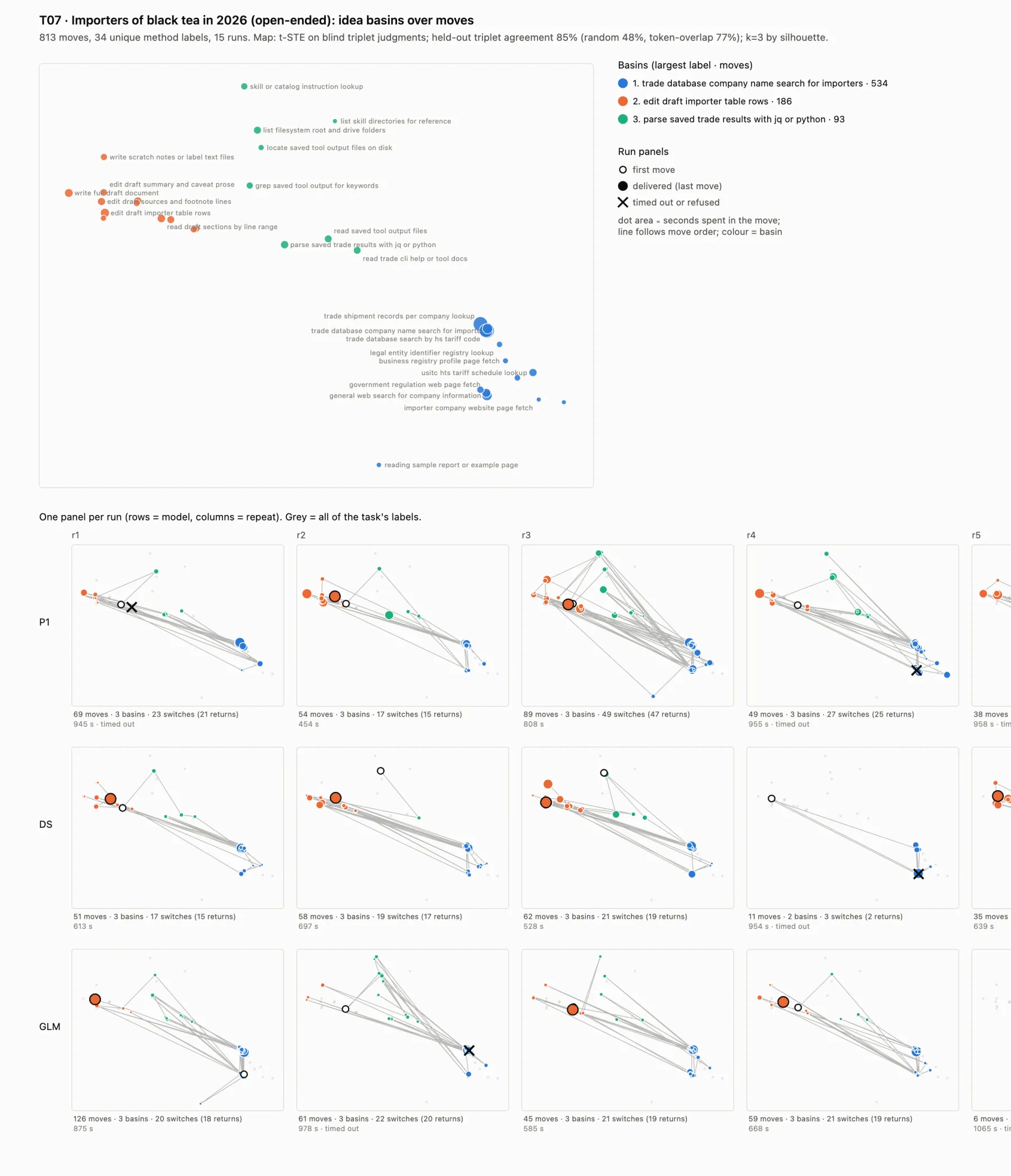
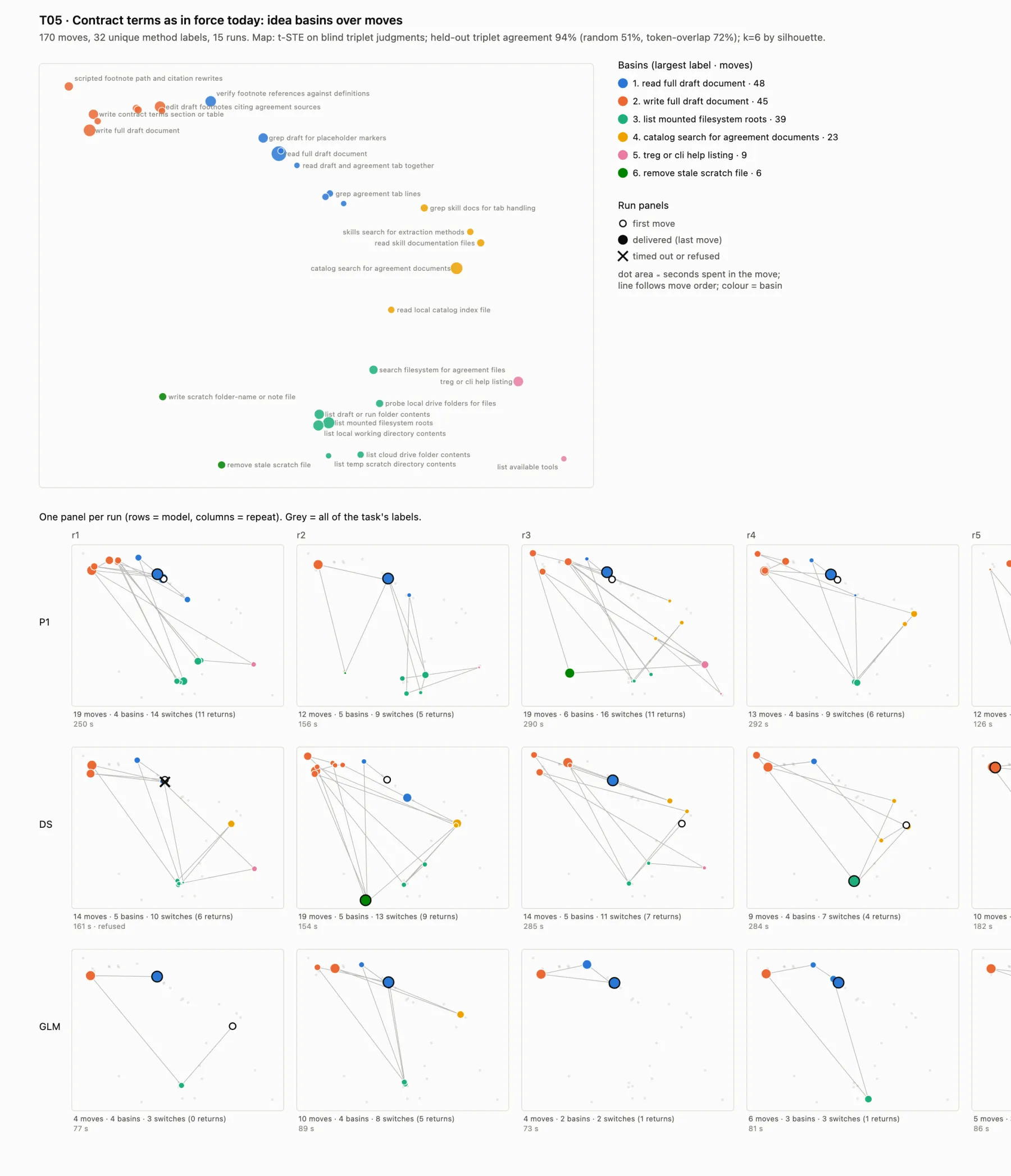
A move is a stretch of consecutive tool calls with the same purpose, such as fetching SEC filings or editing the draft. Claude Haiku named each move from a per-task list, blind to the model; then, for triples of names, it judged which two approaches are closer, asked twice with the order swapped. A t-STE embedding of those judgments places the names on a map, and k-means divides each task's map into 3 to 7 basins. On held-out judgments the maps agree 81% to 100% of the time, against about 52% by chance; 4,988 moves in all.
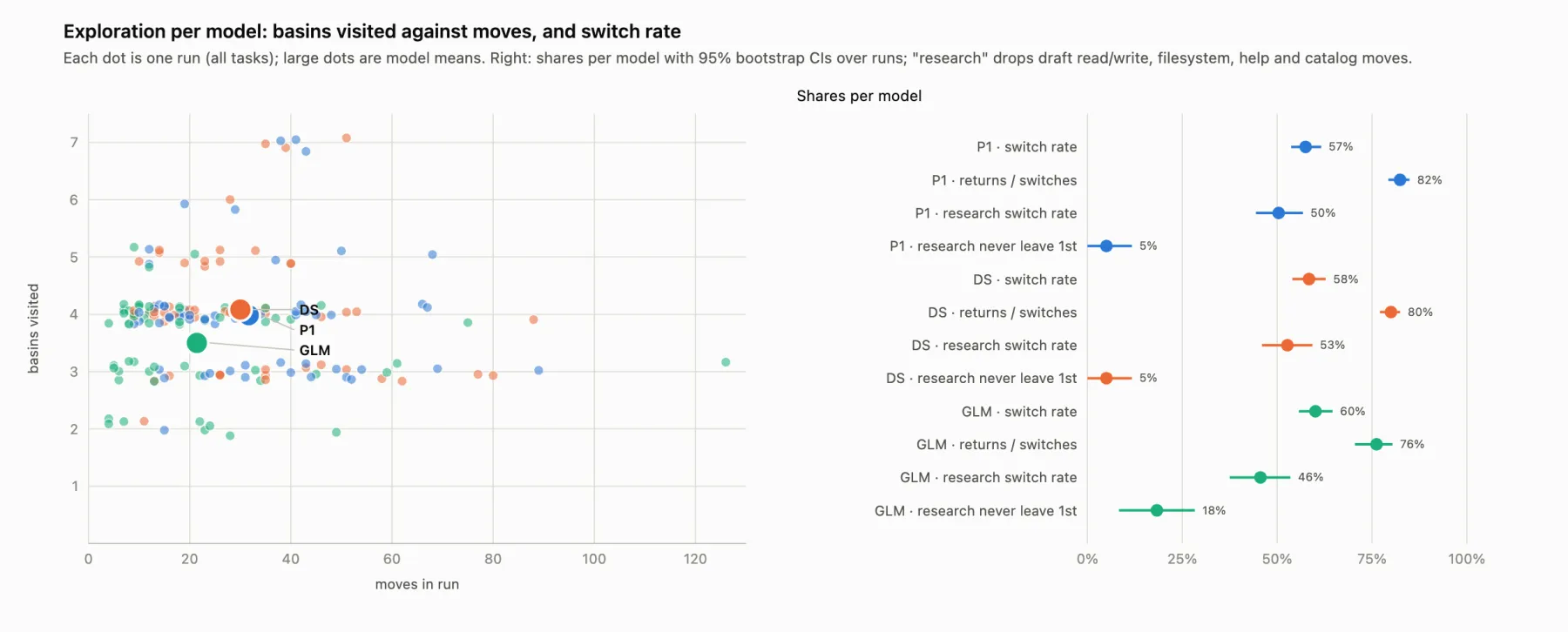
Counting only research moves, the ones that read sources rather than the run's own draft or filesystem: Particle-1 visited 2.87 basins a run, DeepSeek V4.1 Flash 2.80 and GLM-5.3-Flash 2.08. GLM-5.3-Flash never left its first basin in 18% of its runs, against 5% for Particle-1.
That reads like a lack of curiosity, and mostly it is not. Most of the runs that never left their first basin are T05 and T09 runs, tasks whose answer is already in the workbook: a contract in a tab, a table to put formulas on. The rest are T04 and T10 runs whose research stayed inside one of the task's broader basins. The 16 of them that delivered got 97.9% of rows right. Over every run, exploring more did not predict a better grade: runs that never left got 92.2%, the rest 90.3%.
T10 is the exception. There facts go stale, and more research moves went with higher accuracy (Spearman 0.52 over 15 runs): the runs that went on to news and leadership pages are the runs that caught NVIDIA. In T07 the relation runs weakly the other way (Spearman -0.28 over 9 delivered runs).
Most movement is going back. 79% of all switches between research basins return to a basin the run had already visited: search, fetch, back to search, the same loop at a larger scale.
The maps are less stable than the accuracy tables. The number of basins is chosen per task by the clustering, and a different choice moves each model's count by a few tenths. The ordering is stable: Particle-1 and DeepSeek V4.1 Flash visit about the same number of basins, and GLM-5.3-Flash fewer. On this measure, post-training did not change how widely the runs searched.
Your own assistant can use the same workbooks
Nothing in these runs is special to the benchmark. Each run worked in a hedwigai workbook: it read the seed tabs, searched and fetched the web, and wrote its table back, every write kept as a new version with its sources. The harness here was Claude Code, and the same workbooks are open to whichever harness or assistant you already use.
In Claude Code, one line connects it; then /mcp to sign in:
claude mcp add --transport http hedwigai https://mcp.hedwigai.com
Claude Desktop and claude.ai add hedwigai from the Claude directory. Grok, ChatGPT, Cursor, Codex and any other assistant that takes a remote MCP server connect to the same address, https://mcp.hedwigai.com; the agents page has the steps for each. Your assistant can then make a workbook, read and write its tabs, or start a research run on it, and every edit lands as a version you can check against its sources and undo.
The data
Every run is on Hugging Face as hedwigai/model-bench-v2: the delivered documents, the full traces, both graders' grades, the answer keys with the T10 correction logged, and the rubric, under CC BY 4.0. The traces are complete tool-call records, for anyone studying how post-training shows up in agent behaviour.
- Collected 13 November 2026 as hedwigai workbook runs, the harness Claude Code with compaction, each model reached through hedwigai's portal: particle-ai/particle-1, deepseek/deepseek-v4.1-flash-1017, zai-org/GLM-5.3-Flash.
- A graded run is a task, repeat and model; for T12, which is two instructions on one workbook, the second step's document.
- Two DeepSeek V4.1 Flash runs, T05 r1 and T09 r2, ended on a harness error rather than a model one and score as delivering nothing; without them DeepSeek V4.1 Flash gets 92.5%.
- T07's rows cite a site that refused the graders' requests; a row that could not be checked scores as not right, so T07 is low for all three models.
- Grader A graded all 180 runs; grader B, a different model, 35 picked at random, 20% of each task. Agreement is per row, correct against not correct.
- How the benchmark was built and run, including what broke along the way, is in the behind-the-scenes report.
- Figures generated 2026-11-13 18:34 UTC.